
 FrontiersMind
Introducing Lumma-0.6B
A 0.6-billion-parameter foundation model, pre-trained from scratch on 1 trillion tokens, with a 12,288-token context window and a KV cache half the usual size.
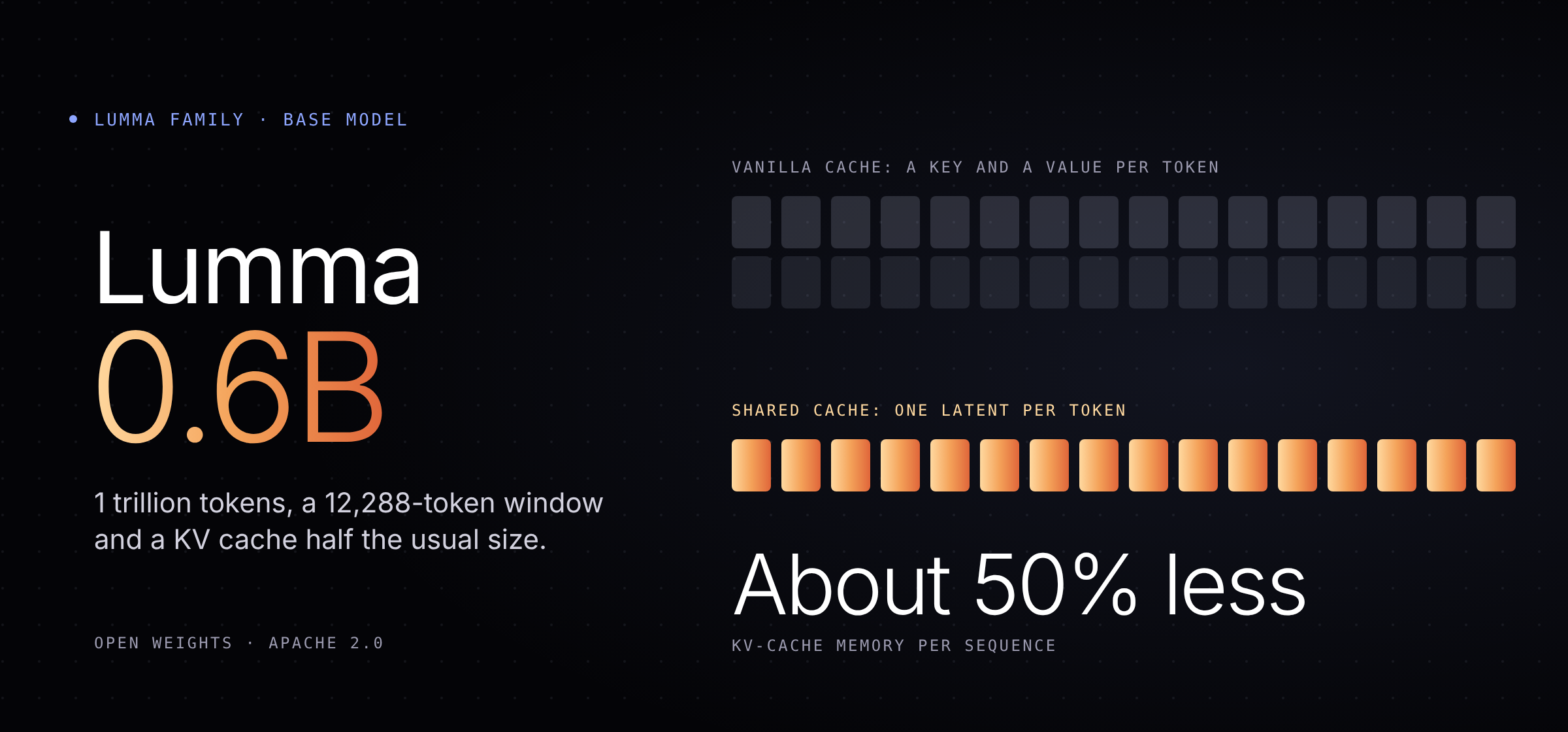
Long context is a memory problem long before it is a compute problem. Every token a model has read leaves a trace in its KV cache, and at 12,000 tokens a single conversation already carries a cache nearly as large as the model's own weights. Multiply that by the number of people you serve, and the cache is what decides your hardware bill.
Lumma-0.6B is built around that fact. It is a decoder-only foundation model, pre-trained from scratch on 1 trillion tokens of English and ten Indic languages, with open weights under Apache 2.0 and an architecture that keeps one tensor in memory where others keep two.
This post covers that idea, what it does to memory, how the model reads Indic scripts, and how it measures up, honestly, against models trained on many times more data.
Overview
A Foundation Model for Long Context
Lumma-0.6B is the 0.6-billion-parameter base model of the Lumma family. It was trained from scratch, with no borrowed weights, and it reads up to 12,288 tokens at once.
pre-trained from scratch, bf16 weights
of pre-training data, English plus ten Indic languages
tokens, 6× a 2,048-token window
in shared mode, the default
| Spec | Value |
|---|---|
| Architecture | Decoder-only Transformer, no layer sharing |
| Layers | 30 |
| Hidden size | 1,440 |
| Attention | Grouped-query: 16 query heads, 8 key-value heads, head dimension 90, QK normalization |
| KV cache | Shared (default) or vanilla, switchable at load time |
| Feed-forward | SwiGLU, intermediate size 3,280 |
| Normalization | RMSNorm, no biases |
| Positions | RoPE, base 1,000,000 |
| Embeddings | Factorized (rank 512), input and output tied |
| Vocabulary | 131,072 tokens |
| Context length | 12,288 tokens |
| Pre-training | 1T tokens |
| Languages | English, Hindi, Bengali, Tamil, Telugu, Marathi, Gujarati, Kannada, Malayalam, Punjabi, Odia |
| License | Apache 2.0 |
Head dimension is hidden size divided by head count. Source: the Lumma-0.6B-Base model card and its config.
Architecture
The Architecture at a Glance
Here is the whole model in one picture, read from the bottom up: tokens enter at the bottom, pass through 30 blocks, and leave as next-token probabilities at the top. The panel on the right zooms in on the attention layer, where Lumma differs most.
Figure · Lumma-0.6B Decoder Stack
One Tensor, Two Jobs
Standard attention keeps two things for every token it has read: a key, which says what the token is about, and a value, which says what it contributes. Grouped-query attention shrinks both by sharing them across heads, but it still stores both.
Lumma-0.6B has no separate value projection at all. Each token is projected once, into a single latent. From that latent the model reads two things. The value is the latent exactly as stored. The key is the same latent after a light normalization and a rotary position encoding. One tensor goes into the cache, and two roles come out of it.
Figure 1 · One Latent, Two Roles
Keys and values are produced from the same token, so they are not independent, and letting them share a source costs little. The benchmark results below suggest that at this scale it does cost little, while halving what has to be remembered.
Position is the subtle part. RoPE rotates a key by an amount that depends on where its token sits in the sequence, so the cache holds the latent before rotation, and the model applies the key norm and the rotation to the history as it reads it. Values are never rotated.
That is the trade: memory for arithmetic. Reading the cache costs a little more compute per step, and in exchange the cache is half the size. For long context, where decoding is limited by how much memory has to be moved, that is the right side of the trade.
It is one switch. Set model.config.kv_cache_mode to "shared" for about 50% lower KV-cache memory, slightly higher compute and the best fit for long context, or to "vanilla" for a conventional cache with lower compute and the broadest framework compatibility. Same weights either way.
If the idea sounds familiar, it is a relative of our Grouped Value Attention research, which starts from the same observation, that keys and values are not independent, and takes a different route to a cache about half the size of grouped-query attention.
Memory
What Half a Cache Looks Like
The arithmetic is short. Each layer caches 8 key-value heads of width 90, which is 720 values per token. In vanilla mode that is stored twice, once for keys and once for values. Across 30 layers in bf16, that comes to 86.4 KB per token in vanilla mode and 43.2 KB in shared mode.
Figure 2 · Cache Per Sequence, by Context Length
At the full 12,288-token window, one sequence needs about 1.06 GB of cache in vanilla mode and about 0.53 GB in shared mode. Serve 32 full-length conversations at once and the cache is 34 GB against 17 GB. That is memory you can spend on more users instead.
Block
The Rest of the Block
Around the shared cache sits a modern, stable core, with a few choices made for long windows and a small budget.
QK Normalization
RMSNorm on queries and keys, per head, before RoPE. A standard stabilizer for attention scores over long sequences.
Factorized and Tied
A 131,072 × 512 table plus small projections, about 69M parameters. A full-width table would hold about 189M.
Wide RoPE Base
A rotary base of 1,000,000 spaces the frequencies for a 12,288-token window, and grouped-query attention shares 8 key-value heads across 16 query heads.
Languages
A Long Window Only Helps If Your Language Fits
Context length is counted in tokens, not words. A tokenizer that splits Indic scripts into many fragments quietly shrinks the window: 12,288 tokens is a long document in English and a short one in Telugu. Lumma-0.6B uses the same Indic-first tokenizer as Nandi-Mini, with a 131,072-token vocabulary built for English and ten Indic languages together.
The chart shows what that means for the window. In English the tokenizers are level. In Indic languages, a 12,288-token window holds between about 4 and 8 times as many words as it does under Qwen3-0.6B's tokenizer.
Figure 3 · Words in the Window, by Language
Show tokens per word and the arithmetic
| Language | Lumma tokens per word | Qwen3-0.6B tokens per word | Lumma words in 12,288 tokens | Qwen3-0.6B words in 12,288 tokens |
|---|---|---|---|---|
| English | 1.18 | 1.16 | 10,414 | 10,593 |
| Hindi | 1.32 | 5.14 | 9,309 | 2,391 |
| Tamil | 2.05 | 10.93 | 5,994 | 1,124 |
| Telugu | 1.77 | 13.38 | 6,942 | 918 |
| Malayalam | 2.05 | 14.56 | 5,994 | 844 |
The tokenizer does not win everywhere. Sarvam-1 needs fewer tokens per word on Hindi (1.25 against 1.32) and on Odia (2.18 against 2.68). On Bengali, Gujarati, Kannada, Malayalam, Punjabi, Tamil, Telugu and Assamese, Lumma-0.6B's tokenizer is ahead of Sarvam-1, and on Assamese the gap is large: 1.51 tokens per word against 4.31.
Results
One Trillion Tokens, Measured Honestly
We evaluated Lumma-0.6B-Base on five standard tasks, next to the half-billion-parameter models closest to it. The most important column is not accuracy but tokens: Lumma-0.6B saw 1 trillion, and its comparisons saw between 1.3 and 18.
Lumma-0.6B-Base, trained on 1T tokens
than Qwen-2-0.5B, with a higher average (44.47 against 44.02)
of MobiLlama-0.5B, which saw 30% more tokens (1.3T)
behind Qwen2.5-0.5B (47.78), which saw 18× the data
Figure 4 · Score Against Training Data
Figure 5 · Five Tasks and the Average
Show the full table
| Model | Tokens (T) | HellaSwag | Winogrande | OBQA | ARC-e | ARC-c | Avg. |
|---|---|---|---|---|---|---|---|
| MobiLlama-0.5B-Base | 1.3 | 39.65 | 53.67 | 30.60 | 52.82 | 23.63 | 40.07 |
| Qwen-2-0.5B-Base | 12 | 49.01 | 57.69 | 33.20 | 54.79 | 25.42 | 44.02 |
| Qwen2.5-0.5B-Base | 18 | 52.16 | 56.82 | 35.40 | 64.64 | 29.86 | 47.78 |
| Lumma-0.6B-Base | 1 | 46.25 | 54.14 | 32.80 | 60.60 | 28.58 | 44.47 |
Read it plainly. Lumma-0.6B beats MobiLlama-0.5B on every task with fewer tokens. Against Qwen-2-0.5B it leads on the two ARC tasks and trails on HellaSwag, Winogrande and OpenBookQA, which nets out to a slightly higher average on one twelfth of the data. Against Qwen2.5-0.5B, trained on eighteen times as much, it is behind on all five. This is a base model, and the point of these numbers is that a strong foundation does not need the largest token budget.
Family
The Lumma Family
Lumma-0.6B-Base is the foundation of the 0.6B family, with open weights on Hugging Face.
Lumma-0.6B-Base
The pre-trained foundation model described in this post.
Lumma-0.6B-Instruct
The instruction-following release.
Lumma-0.6B-Tool
The tool-use release.
Lumma-0.6B-Extract
The extraction release.
Lumma-Fev
The Lumma name also carries our decision models, which score your options in one pass.
The full set is in the Lumma collection.
Run
Run It Yourself
The architecture is custom, so loading it needs trust_remote_code=True. The cache mode is a one-line setting.
# pip install transformers==5.4.0
from transformers import AutoModelForCausalLM, AutoTokenizer
import torch

model_name = "FrontiersMind/Lumma-0.6B-Base"

tokenizer = AutoTokenizer.from_pretrained(model_name, trust_remote_code=True)
model = AutoModelForCausalLM.from_pretrained(
    model_name, trust_remote_code=True, dtype=torch.bfloat16
).eval()

# Memory-efficient mode (default): one cached latent per token
model.config.kv_cache_mode = "shared"
# Standard mode: keys and values cached separately
# model.config.kv_cache_mode = "vanilla"

inputs = tokenizer("The world is a strange place", return_tensors="pt").to(model.device)
outputs = model.generate(**inputs, max_new_tokens=50, do_sample=True,
                         temperature=0.3, top_p=0.95, top_k=20,
                         repetition_penalty=1.1)
print(tokenizer.decode(outputs[0], skip_special_tokens=True))
For serving, Lumma-0.6B-Base runs on vLLM and SGLang with OpenAI-compatible endpoints, and on Docker Model Runner with one command:
docker model run hf.co/FrontiersMind/Lumma-0.6B-BaseThe exact serving commands are on the model card.
Fit
Where Lumma Fits
Reach for Lumma-0.6B when context and memory are the constraint: long documents in English or Indic languages, many concurrent sessions on limited accelerators, or on-premises serving where every gigabyte of cache is a gigabyte you own and pay for. It is a good base for fine-tuning, and the instruct, tool and extraction releases are there when you want a starting point that already follows directions.
Know its edges. It is a base model, and base models are not recommended for conversation without post-training: supervised fine-tuning, RLHF or continued pre-training. On general benchmarks it sits behind Qwen2.5-0.5B, which saw far more data. And its tokenizer trails Sarvam-1 on Hindi and Odia.
The Takeaway
Lumma-0.6B asks a simple question of the KV cache: why remember two things when one will do? Keys and values read from a single stored latent, a cache half the size, and a window that stays useful in the languages it was built for. It was trained from scratch, it is open, and it runs on hardware you own. That is Sovereign Superintelligence in a small package.